QR codes vs barcodes: Understanding the key differences
You've seen both on products, barcodes have been standard for decades, and QR codes are everywhere now. They look completely different and do different things. Choosing between them isn't complicated once you understand what each excels at. Most modern products actually use both.
What are barcodes?
Barcodes have been around since the 1970s. They're the vertical black-and-white stripes you see on product packaging. Each pattern encodes a number, usually a product ID. A barcode scanner reads these stripes using a laser or camera. That's it. Simple, fast, reliable. They were designed for one purpose: quickly identifying products at checkout. That focus made them extremely efficient.
Data capacity comparison
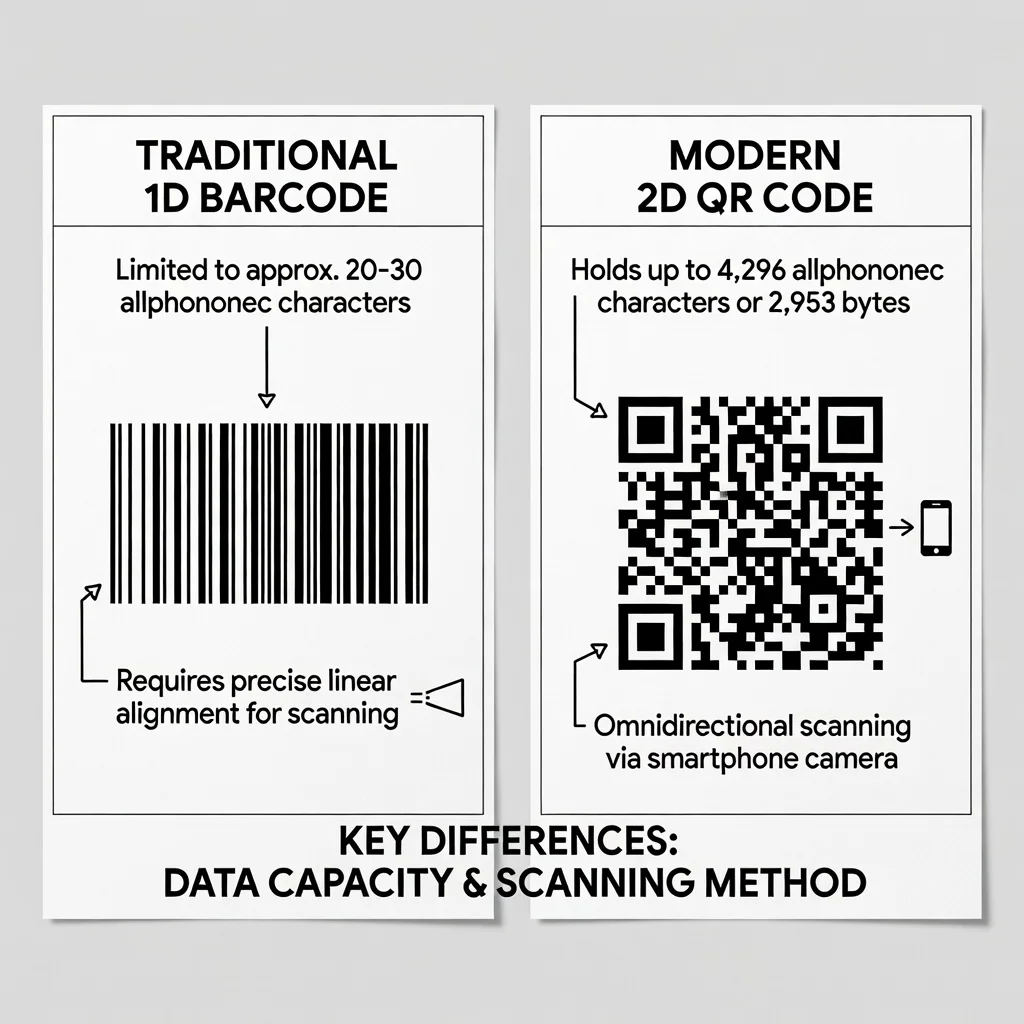
Here's the fundamental difference: a barcode stores about 10-20 characters, basically just a product number. A QR code stores up to 4,000 characters. You can fit an entire URL, contact information, or detailed product description in a QR code. You cannot do this with a barcode. This capacity difference drives everything else about how they're used.
Scanning technology
Barcodes need specialized barcode scanners, the devices you see at checkout counters. QR codes can be scanned with any smartphone camera and a free app. No special equipment. This accessibility completely changes where each technology can be used. You can put a QR code on a museum exhibit, and visitors scan it with their phone. Barcodes require actual hardware infrastructure.
Directionality and flexibility
Barcodes must be oriented correctly, they can't be upside down or tilted at odd angles. QR codes work from any angle. Rotate a QR code 90 degrees and it still scans. This flexibility makes QR codes useful in situations where you can't control orientation. It also means QR codes work better in chaotic environments like restaurants or retail floors.
Speed and efficiency
Barcodes are faster to scan than QR codes in high-volume situations. A supermarket checkout scans hundreds of barcodes per hour. Barcode scanners are optimized for speed. QR codes are nearly as fast but not quite. In retail settings where throughput matters, barcodes still win. For everything else, the speed difference is negligible.
Cost comparison
Barcodes cost less to print and have been optimized for cost efficiency over fifty years. QR codes are more expensive individually, but the cost gap has narrowed. What really matters is infrastructure: barcodes require scanner hardware, which is expensive. QR codes work with phones everyone already has. For one-off projects, QR codes are often cheaper overall.
Current use cases: Barcodes
- Product identification and point-of-sale transactions (primary retail use)
- Inventory management and warehouse operations
- Library systems and catalog management
- Package tracking and logistics
- Medication tracking in healthcare
- High-volume automated scanning environments
Current use cases: QR codes
- Marketing campaigns and advertising materials
- Mobile payments and transactions
- Event ticketing and access control
- Product authentication and counterfeit prevention
- Contactless information sharing (menus, WiFi, contact details)
- Consumer-facing marketing and brand engagement
- URL sharing and digital content linking
Hybrid approaches: QR code and barcode combination
Modern products often display both, and this makes sense. The barcode handles the automated checkout; the QR code gives customers access to reviews, authenticity verification, and product details through their phone. One technology handles the backend, the other handles customer engagement. They work better together than apart.
Industry trends and future outlook
Barcodes aren't going anywhere, they're too entrenched in retail and logistics. But QR codes are expanding into spaces barcodes can't reach. Mobile commerce, contactless interaction, consumer engagement, these are all QR code territory. The future isn't one replacing the other. It's both, doing what each does best.
Choosing between barcodes and QR codes
Choose barcodes for high-volume retail scanning and existing infrastructure where scanners are already in place. Choose QR codes for consumer engagement, marketing, or when you need to encode detailed information. If you can, use both. The combination gives you the best of each technology.
Generate QR codes for consumer engagement and marketing using our free QR code generator. Complement your barcode systems with mobile functionality.