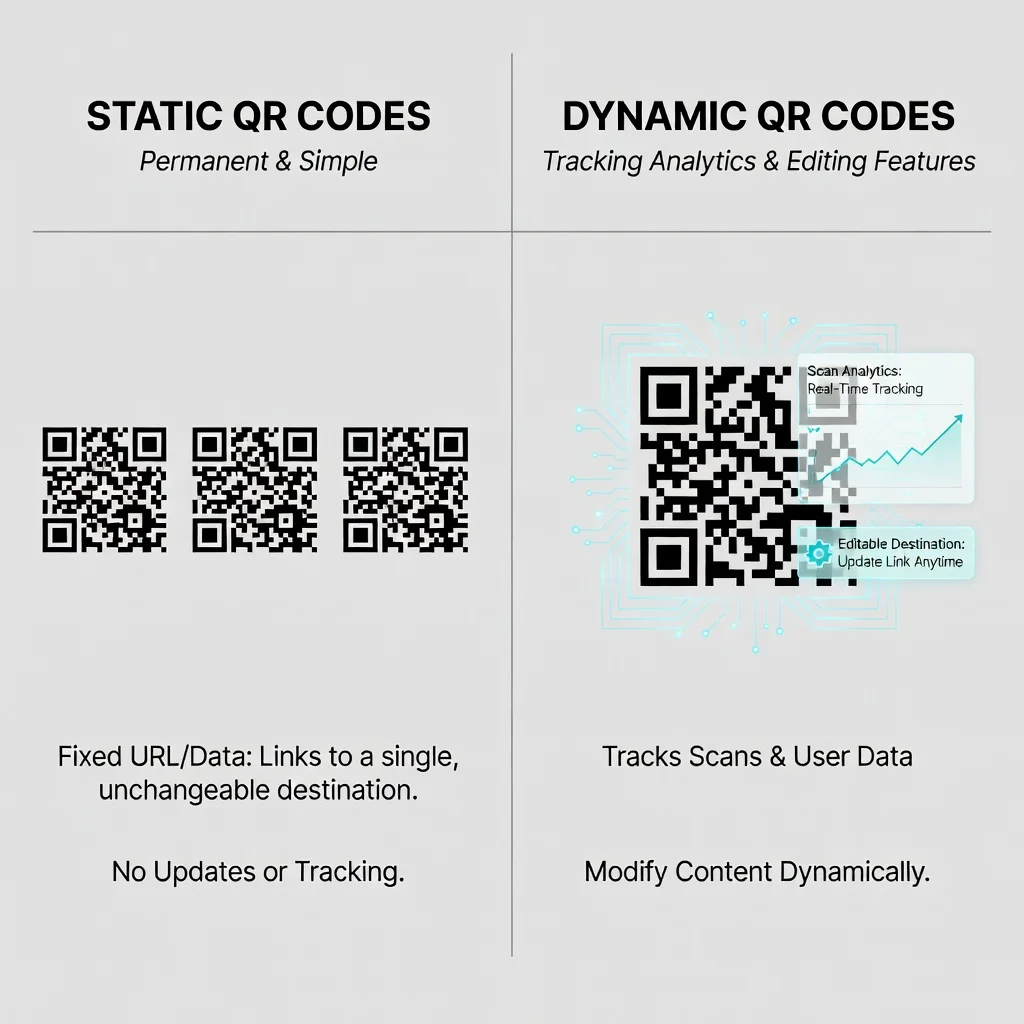
Static QR codes encode the data directly into the pattern, so they are free, permanent, and never expire; dynamic QR codes route through a server, so you can edit the destination and track scans, but they require a paid subscription. For most people a free static QR code is all you need. Choose dynamic only when you must change the destination after printing or need scan analytics.
Static vs dynamic QR codes at a glance
| Factor | Static QR code | Dynamic QR code |
|---|---|---|
| Editable after printing | No | Yes |
| Scan tracking and analytics | No | Yes |
| Expires | Never | If the subscription lapses |
| Cost | Free | Paid subscription |
| Where the data lives | In the code itself | On a redirect server |
| Best for | Permanent, one-time uses | Campaigns needing edits or analytics |
Static vs dynamic QR codes: Understanding the difference
There are two fundamentally different types of QR codes, and which one you choose affects everything from cost to flexibility to tracking capability. The difference is technical but the practical implications are straightforward: static codes are permanent and free, dynamic codes are flexible and provide data. Knowing when to use each type prevents you from creating a code you regret later.
What are static QR codes?
A static QR code contains your data directly encoded in the pattern itself. When you create a static code pointing to "https://example.com," that exact URL is embedded in the black and white squares. The pattern is fixed. Someone scans it? They get sent to that URL, always, forever. The data is baked into the code and cannot be changed. This is what most free QR code generators produce, simple, straightforward, permanent.
Advantages of static QR codes
- Completely Free: No subscriptions, no ongoing payments. Generate, download, use forever.
- Permanent: Works indefinitely. No server dependency, no company holding your code hostage, no service that can go out of business.
- Reliable: The code itself cannot break because it's not connected to anything external. The pattern you create today works exactly the same way in 10 years.
- Privacy-Focused: No tracking, no analytics, no data collection about who scans your code. The code just works without sending information anywhere.
- Minimal Setup: Generate, download, use. No account creation, no password, no configuration needed.
- Long Lifespan: The code remains scannable as long as the physical pattern is intact. Wear and fading don't matter much due to error correction.
Disadvantages of static QR codes
- Cannot Be Updated: If your destination URL changes, you need a completely new QR code. The old one still points to the old destination.
- Zero Tracking: You have no idea how many people scan your code or when they scan it. No engagement data at all.
- No Flexibility: One code, one destination. You can't show different content to different audiences or adjust your destination based on time of day or other conditions.
- Size Limitations: Longer URLs create larger codes. A complicated destination can result in a noticeably bigger code that takes up more space on your materials.
- Maintenance Headaches: If your website goes down or the link breaks, the code becomes useless. You can't fix it, you have to reprint.
What are dynamic QR codes?
Dynamic QR codes use a short redirect URL instead of encoding your actual destination. When you create a dynamic code, the pattern contains something like "https://qr.example.com/abc123" rather than your actual destination. The redirect service at that address stores the mapping: "abc123" points to "https://your-actual-website.com." Someone scans the code, gets redirected to the shortener, which then sends them to your real destination. The user sees nothing different, it's instant from their perspective. But behind the scenes, your code points to a redirect service you control.
Advantages of dynamic QR codes
- Update Anytime: Point your code to a different URL without creating a new code. Change your destination without reprinting materials.
- Complete Tracking: See exact scan counts, timing, geographic location, device type, and other analytics. Understand which placements actually drive engagement.
- Maximum Flexibility: Redirect different audiences to different destinations. A/B test different landing pages. Change where the code points based on time or other conditions.
- Smaller Code Size: Since the pattern only contains a short redirect URL, the code stays small even if your actual destination is long.
- Easy Maintenance: Broken link? Update the redirect. Need a new destination? Change it in the dashboard. No reprinting needed.
- Campaign Management: Create multiple codes pointing to different destinations but track everything from one dashboard. Perfect for marketing campaigns.
Disadvantages of dynamic QR codes
- Ongoing Costs: Dynamic QR code services require subscriptions or per-code fees. You're paying for the infrastructure that runs the redirect service.
- Dependency: Your code only works if the redirect service is running. If the service goes down, your code breaks. If the company goes out of business, your codes become non-functional.
- Complexity: More setup required. Account creation, dashboard access, configuration. Not as simple as generating and downloading.
- Data Privacy: Using a redirect service means scan data is collected and stored by the provider. If you care about user privacy or have GDPR concerns, this matters.
- Dependency on Third Party: You're trusting a service to keep your redirects active. Company issues, account suspension, or policy changes could affect your codes.
When to use static QR codes
Product Packaging: Your product packaging won't change. The code can point to your product page or assembly instructions forever. Static is perfect here.
Permanent Signage: A code on a building pointing to company website, indoor directory pointing to room information, museum exhibit with educational content. These don't need updates.
Business Cards: Your contact information probably won't change frequently. A static code with your vCard or website is appropriate.
Limited Budget: If you're generating a few codes for personal use or small projects, static codes are free and perfectly adequate.
Privacy-Sensitive Applications: If collecting scan data is a concern or unnecessary, static codes don't track anything.
When to use dynamic QR codes
Marketing Campaigns: Tracking engagement matters. Print materials, ads, email campaigns, all benefit from knowing how many scans you're getting and when.
Seasonal or Time-Limited Offers: Promotional codes that change seasonally or periodically. Update the destination without printing new materials.
Retargeting Different Audiences: Same code on different platforms, but different destinations for each audience. You can A/B test or customize the experience.
Frequently Changing Content: Event registration links that change, software download pages that get updated, special offers that rotate. Dynamic codes handle frequent updates.
Analytics-Focused Use: If understanding engagement and tracking performance is important, dynamic codes provide the data you need.
Professional Campaigns: Established companies with budgets for measurement and optimization. Dynamic codes are standard for professional marketing.
The hybrid approach
Some organizations use both. Static codes for permanent, unchanging content. Dynamic codes for campaigns and time-sensitive materials. A retail company might use static codes on product packaging but dynamic codes on promotional posters and email campaigns. This gives you the cost savings of static codes where permanence doesn't matter, and the flexibility of dynamic codes where it does.
Real-world example: Restaurant menu codes
Static Approach: Print QR codes linking to your menu PDF. When you change your menu next month, those codes are useless. You have to reprint everything.
Dynamic Approach: Use a dynamic code linking to your digital menu. Menu changes? Update the destination. Same code works forever. You know how many people scanned it and when.
Most restaurants adopted dynamic codes for exactly this reason, the flexibility to update without reprinting was too valuable to pass up.
Cost comparison
Static: Free to generate unlimited codes.
Dynamic: Typically $5-$30/month depending on features and scan volume. Some services offer free plans with limited functionality.
The ROI calculation is simple: if the value of tracking and flexibility exceeds the subscription cost, dynamic codes make sense. For one-time campaigns or large print runs you're not planning to change, static codes are obviously the answer.
Technical note: Can you convert one to the other?
No. A static code is fixed. A dynamic code points to a redirect service. You can't convert between them, you have to generate a new code. This is worth considering when choosing which type to use. Once you print static codes on 10,000 flyers, you're committed to that destination.
Conclusion
Static codes are for when you know the destination is permanent and don't need tracking. Dynamic codes are for campaigns, frequent updates, and situations where analytics matter. Neither is objectively "better", they solve different problems. Choose based on your actual needs, not just because one has more features.
Frequently asked questions
Are static or dynamic QR codes better?
Neither is universally better, they solve different problems. Static codes are free, permanent, and never expire, which makes them the right choice for a business card, a WiFi code, product packaging, or any link that will not change. Dynamic codes let you edit the destination after printing and track scans, which matters for marketing campaigns, A/B testing, and printed assets you cannot easily reprint. If you do not need editing or analytics, a free static code is the simpler, more reliable option.
Do static QR codes expire?
No. A static QR code encodes the destination directly into the pattern, so there is no server in the middle that can shut off. As long as the destination exists, the code keeps working indefinitely. Only dynamic codes can stop working, because they depend on a third-party redirect service staying online and your subscription staying active.
Can I turn a static QR code into a dynamic one?
No. Because a static code has the destination baked into its pattern, changing where it points means generating a new code. If you anticipate needing to change the destination, start with a dynamic code from the beginning, or point your static code at a URL you control (such as a short link or a page on your own site) so you can update the page rather than the code.
Are dynamic QR codes free?
Generating a dynamic QR code almost always requires a paid subscription, because the provider has to host and maintain the redirect server that makes editing and analytics possible. Static QR codes, by contrast, are free to create with no ongoing cost. If a tool offers free dynamic codes, check whether they expire after a trial, as that is a common catch.
Try it now at FreeQRCodeGenerator.com →